
Lanxiang HuI'm a final-year PhD candidate at UCSD, fortunately advised by Prof. Hao Zhang and Prof. Tajana Šimunić Rosing, working on efficient and reliable AI systems. I am also a research intern at NVIDIA Cosmos Lab. Previously I was an intern at Snowflake AI research. Before joining UCSD, I have spent wonderful time working as a visiting research intern with Prof. Song Han. I completed my undergrad degree at UC Berkeley with majors in CS and Physics. I design inference acceleration algorithms and systems that turn idle compute into speedups. I also build evaluation infrastructures for interactive AI workloads. Some of my projects include:
|
News
Earlier news
|
Selected Publications |
|
* denotes equal contribution. See Google Scholar for the full publication list. |
Training and Inference Algorithms for Efficient AI |
|
|
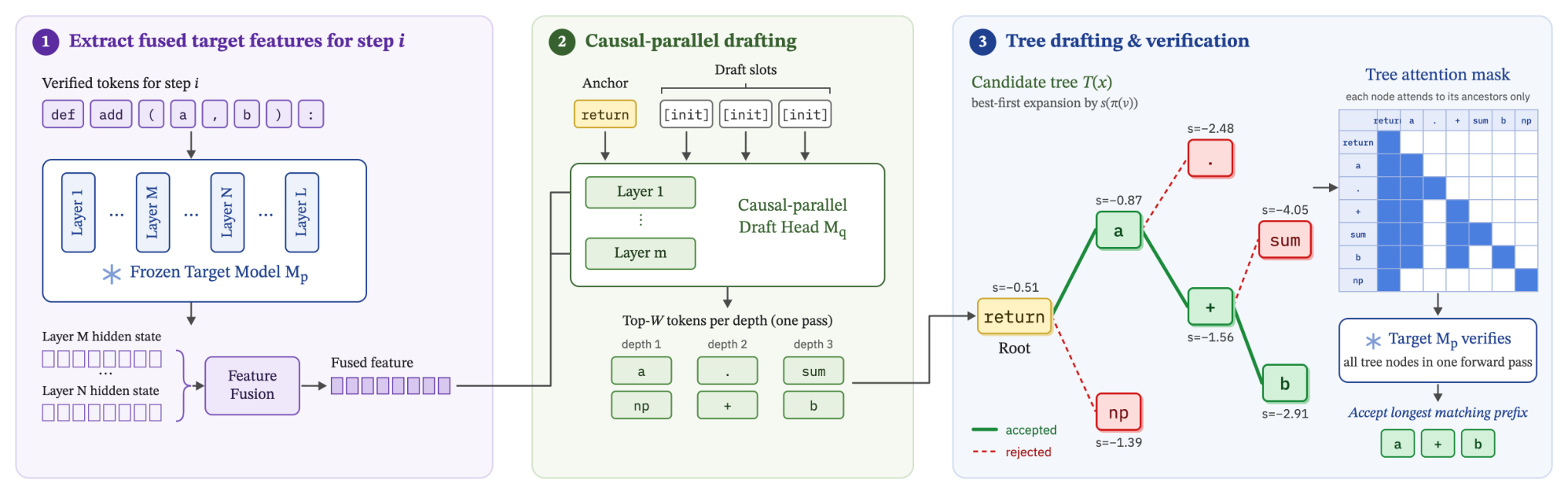
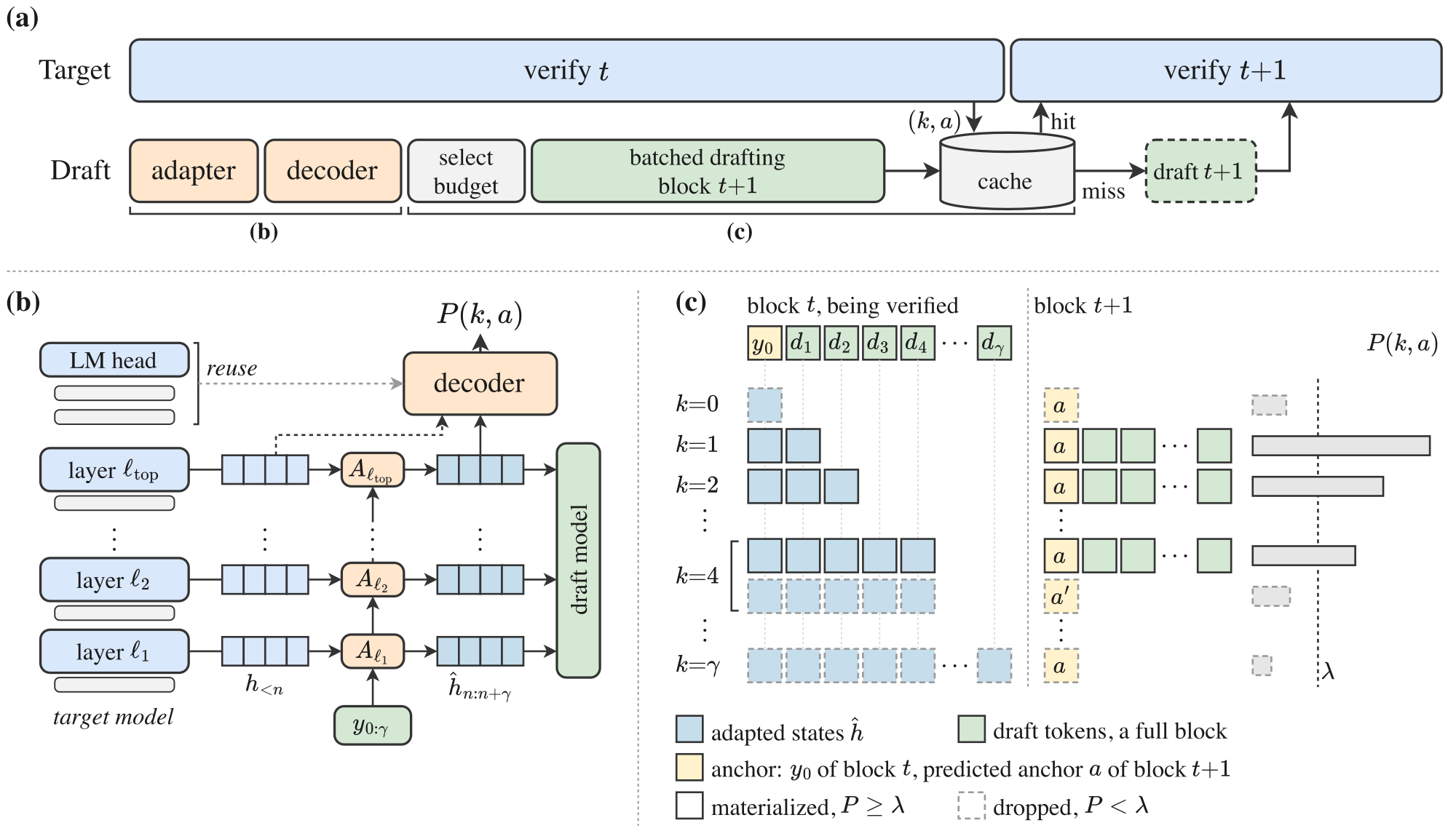
JetSpec: Breaking the Scaling Ceiling of Speculative Decoding with Parallel Tree DraftingLanxiang Hu, Zhaoxiang Feng, Yulun Wu, Haoran Yuan, Yujie Zhao, Yu-Yang Qian, Bojun Wang, Peng Zhao, Daxin Jiang, Yibo Zhu, Tajana Rosing, Hao Zhang Preprint, 2026 arxiv / blog / website / code ★ 257 JetSpec++: Foresight Parallel Drafting with Self RefinementsZhaoxiang Feng*, Lanxiang Hu*, Haoran Yuan, Yu-Yang Qian, Jihui Yang, Peng Zhao, Yibo Zhu, Tajana Rosing, Hao Zhang Preprint, 2026 arxiv / website / JetSpec trains a causal parallel draft head that drafts a whole candidate tree in one forward pass, with up to 9.64x speedup on MATH-500. JetSpec++ adds self refinement and drafts the next block while the current one is verified, running up to 1.5x faster than DSpark with higher throughput and lower per-user latency at moderate concurrency. |

|
Fast and Accurate Causal Parallel Decoding using Jacobi ForcingLanxiang Hu*, Siqi Kou*, Yichao Fu, Samyam Rajbhandari, Tajana Rosing, Yuxiong He, Zhijie Deng, Hao Zhang ICML, 2026 arxiv / website / code ★ 119 Jacobi Forcing trains causal parallel decoders that are able to generate high-quality drafts conditioning on noisy context. On coding and math tasks, Jacobi Forcing achieves up to 4.5x speeudp with minimal to no performance loss. |

|
Stronger-MAS: Multi-Agent Reinforcement Learning for Collaborative LLMsYujie Zhao, Lanxiang Hu, Yang Wang, Minmin Hou, Hao Zhang, Ke Ding, Jishen Zhao ICLR, 2026 arxiv / website / code ★ 228 We introduce an on-policy RL algorithm, AT-GRPO and a training system for multi-agent system training. Stronger-MAS boosts planning task accuracy from a 14.0–47.0% from single-agent RL baseline to 96.0–99.5%. It also improves reasoning performance with an average gain of 7.62% on coding and 17.93% on math. |

|
TrimLLM: Progressive Layer Dropping for Domain-Specific LLMsLanxiang Hu, Tajana Rosing, Hao Zhang ACL, 2025 arxiv / code we introduce an algorithm to progressively prune MHA and MLP layers during domain-specific SFT to achieve up to 5.7x speedup and 60% less memory consumption in comparison with state-of-the-art model compression algorithms. |

|
CLLMs: Consistency Large Language ModelsSiqi Kou*, Lanxiang Hu*, Zhezhi He, Zhijie Deng, Hao Zhang ICML, 2024 arxiv / website / code ★ 417 We show LLMs can be trained to operate LLMs as highly efficient parallel decoders with 2.4x to 3.4x speedup across a variety of benchmarks. |

|
Online Speculative DecodingXiaoxuan Liu, Lanxiang Hu, Peter Bailis, Ion Stoica, Zhijie Deng, Alvin Cheung, Hao Zhang ICML, 2024 arxiv / code We introduce online speculative decoding algorithm (OSD) with improved responsiveness, speculation accuracy and compatibility with LLM serving systems. |
Evaluation Infrastructures |
|

|
Benchmarking Scientific Understanding and Reasoning for Video Generation using VideoScience-BenchLanxiang Hu, Abhilash Shankarampeta, Yixin Huang, Zilin Dai, Haoyang Yu, Yujie Zhao, Haoqiang Kang, Daniel Zhao, Tajana Rosing, Hao Zhang ECCV, 2026 arxiv / website / code VideoScience-Bench is a benchmark to evaluate video generative world models not only as generators but also as reasoners, requiring their generations to demonstrate scientific understanding consistent with expected physical and chemical phenomena. |

|
Lmgame-Bench: How Good are LLMs at Playing Games?Lanxiang Hu*, Mingjia Huo*, Yuxuan Zhang†, Haoyang Yu†, Eric P. Xing, Ion Stoica, Tajana Rosing, Haojian Jin, Hao Zhang ICLR, 2026 arxiv / website / code ★ 1k We introduce lmgame-bench that evaluates latest large models with games and addresses evaluation challenges by providing scaffolds. We present quantitative analysis of the relationship between model gaming performance and results on existing benchmarks. |

|
GameArena: Evaluating LLM Reasoning through Live Computer GamesLanxiang Hu*, Qiyu Li*, Anze Xie*, Nan Jiang, Ion Stoica, Haojian Jin, Hao Zhang ICLR, 2025 arxiv / website / code We design and build a incentivized dynamic benchmarks to evaluate AI reasoning abilities extending beyond math and coding. |
Media Coverage |


Academic ServicesConference reviewer: ICML, ICLR, NeurIPS, COLM, ACL, ECCV. |
|
© 2026 Lanxiang Hu. Design and source code from Jon Barron's website, powered by Jekyll. |